
When most people think about traffic signals, they think about the hardware they see every day: the poles, the heads, the pedestrian signals, the signs. What they don’t think about is the work that goes into building that infrastructure from scratch versus the work that keeps it running year after year. Those are two very different disciplines, and understanding the difference matters if you’re a municipality trying to figure out what kind of contractor you actually need.
Traffic signal construction is exactly what it sounds like. It starts with a design, moves through permitting and planning, and ends with a fully operational intersection where there wasn’t one before, or a significantly upgraded one replacing outdated infrastructure.
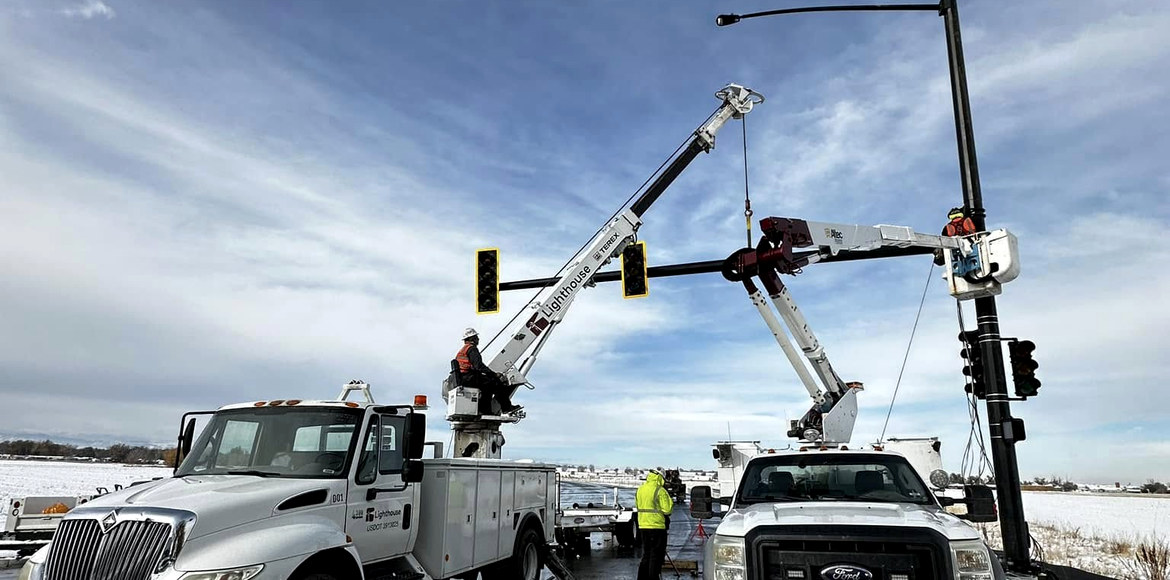
The scope of a construction project typically includes excavation and conduit installation, pole foundations and pole setting, signal head installation and wiring, controller cabinet installation and programming, detection system installation, and coordination with other trades and utilities. It requires a licensed electrical contractor, equipment like bucket trucks and digger derricks, and a crew that can manage a live road environment safely while construction is underway.
Construction projects are finite. There is a start date, an end date, and a punch list. When the project is complete, the contractor moves on.
Maintenance is an ongoing relationship, not a one-time project. A signal maintenance contract typically covers routine inspections, emergency response to outages and failures, repairs and component replacements, software updates and controller adjustments, detection system testing and calibration, and documentation and reporting to the jurisdiction.
Where construction is episodic, maintenance is continuous. A jurisdiction with 50 intersections under a maintenance contract has a contractor who knows every one of those locations, has records of their history, and can respond when something goes wrong at 2am on a Sunday.
The skills required for maintenance overlap with construction but are not identical. A good maintenance technician needs deep diagnostic ability. They are not building from a design plan; they are troubleshooting a system that is already installed, often under pressure, often while traffic is moving around them. IMSA certification levels are the industry standard for measuring that competency.
Not every signal contractor does both construction and maintenance. Some specialize in one or the other. The distinction matters to municipalities for a few reasons.
A contractor that only does construction may not have the diagnostic depth or the 24/7 availability that maintenance requires. A contractor that only does maintenance may not have the equipment or the crew capacity to handle a full intersection build.
A contractor that does both brings a specific advantage: continuity. When the same team that built an intersection is also responsible for maintaining it, they know exactly how it was installed, what decisions were made during construction, and where the potential failure points are. That institutional knowledge has real value when something goes wrong three years down the road.
At Lighthouse Transportation Group, we operate across both sides of this work. Our construction crews build new intersections and handle major infrastructure upgrades. Our service division holds active maintenance contracts across Colorado and Oklahoma, with technicians responding to outages, completing inspections, and keeping systems running day to day. The same company, the same standards, across both disciplines.
If you are a municipality evaluating signal contractors, the right questions are different depending on what you need.
For construction: What is your equipment capacity? Who holds your electrical license? What is your experience with intersections of similar scope and complexity?
For maintenance: What is your emergency response time commitment? How do you document and report? What certifications do your technicians hold? How many intersections are currently under your maintenance contracts?
And if you need both: Can you demonstrate that your construction and maintenance operations are integrated, or are they effectively separate businesses operating under the same name?
The answers to those questions will tell you more about a contractor than any proposal document will.
We’re a small team that loves to create great experiences and make meaningful connections between builders and customers. Join our remote ream!


