
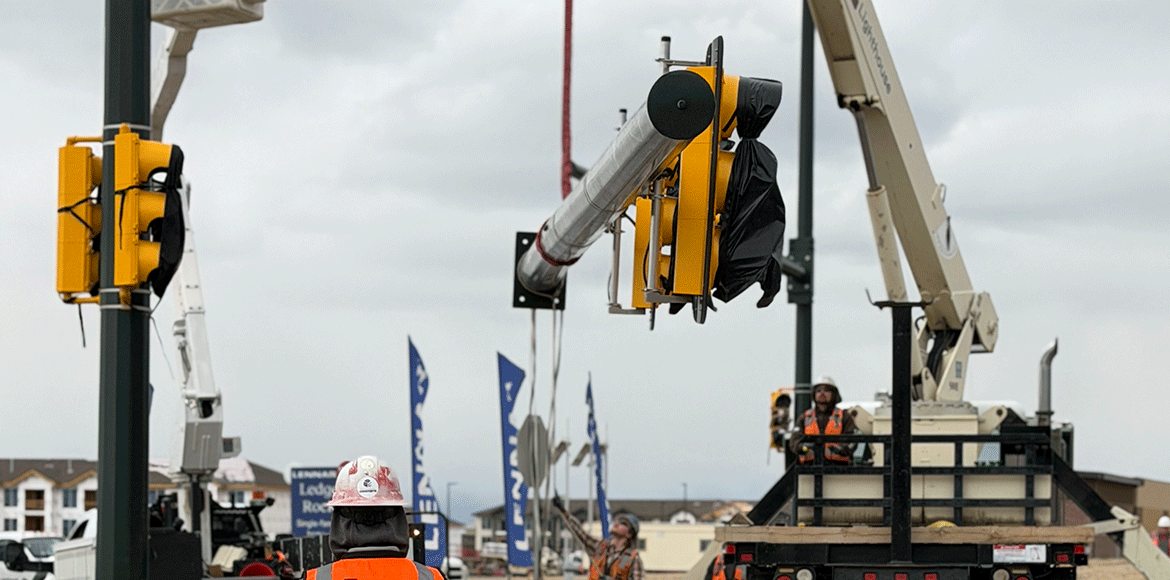
Most people interact with traffic signals dozens of times a day without giving much thought to what is happening behind the lens. You stop, you wait, you go. But the system coordinating all of that is more sophisticated than it looks, and understanding it helps explain why signals sometimes seem out of sync, why some intersections feel more efficient than others, and what it actually takes to keep that infrastructure running.
A traffic signal system has several core components working together. The most visible are the signal heads themselves, the red, yellow, and green lights mounted at intersections. But those lights are just the output. The real work happens in a controller cabinet, typically a metal box mounted at the corner of an intersection that you have probably walked past a hundred times without noticing.
Inside that cabinet is a traffic signal controller, essentially a specialized computer that runs the logic for the intersection. It receives inputs, executes a timing program, and sends outputs to the signal heads. Connected to the controller are detection devices, most commonly loops embedded in the pavement or cameras mounted overhead, that tell the system when vehicles are present in a lane.
Wiring connects everything: conduit running underground from the cabinet to each signal head and detection point, all of it installed and maintained to precise standards. At busier intersections, the cabinet may also contain communication equipment connecting the signal to a centralized traffic management system, allowing engineers to monitor and adjust timing remotely.
Signal timing is not arbitrary. Engineers develop timing plans based on traffic studies that measure volume, speed, and turning movements at an intersection during different times of day. A typical intersection might have three or four different timing plans, one for morning peak, one for evening peak, one for midday, and one for overnight, each with different phase lengths and cycle times calibrated to the expected demand.
A phase refers to the combination of movements that receive the green at the same time. At a standard four-leg intersection, you might have a phase for northbound and southbound through traffic, a phase for northbound left turns, a phase for eastbound and westbound through traffic, and so on. The controller cycles through these phases in a set sequence, with yellow and all-red clearance intervals between each one to allow traffic to clear safely.
When detection is present, the controller can extend or skip phases based on whether vehicles are actually waiting. A left turn phase with no vehicles detected might be skipped entirely to avoid wasting time. A through phase with a heavy queue might be extended up to a maximum threshold before the controller moves on.
Signal systems are infrastructure, which means they age, get damaged, and require ongoing maintenance. Some of the most common issues involve detection equipment. A failed loop detector or misaligned camera can cause a controller to behave as though a lane is always empty or always occupied, leading to timing that doesn't match actual conditions.
Communication failures can knock intersections off coordinated timing plans, causing gaps in progression along a corridor. Power issues, whether from storms, outages, or equipment failures, can reset controllers or cause signal heads to go dark or flash red.
Physical damage is also a reality. Vehicles strike signal poles. Construction projects damage underground conduit. Weather takes a toll on equipment over time. Each of those issues requires a certified technician to diagnose and repair, often under live traffic conditions.
Traffic signal work is not general electrical work. It falls under specific state and local requirements, and technicians typically hold certifications through the International Municipal Signal Association (IMSA) or similar credentialing bodies. The work involves not just electrical knowledge but an understanding of traffic engineering principles, controller programming, and the safety protocols required when working in active roadways.
When a municipality or DOT contracts signal work, they are relying on that contractor to understand the full system, not just the component being installed or repaired. A new signal head installation, for example, requires coordinating with the controller program, verifying phasing, and confirming timing is correct before the crew leaves the site.
At Lighthouse Transportation Group, our teams are certified and trained to work across the full signal system, from underground infrastructure to controller programming. We operate in Colorado and Oklahoma, supporting municipalities and DOTs with construction, installation, and maintenance work that keeps intersections functioning as intended.
The signal at your corner is a small piece of a large, interconnected system. When it works well, you probably don't notice it. That's the goal.
We’re a small team that loves to create great experiences and make meaningful connections between builders and customers. Join our remote ream!


.gif)