
Late August brings a shift that traffic engineers and signal contractors track closely: schools reopen. Thousands of kids start moving through neighborhoods, intersections, and crosswalks on predictable schedules twice a day, and the signal infrastructure that manages those crossings has to be ready for it.
For municipalities that have done the preparation work, the transition is smooth. For those running outdated timing plans or deferred maintenance on school zone equipment, August is when those gaps become visible, usually in the form of near misses, backed-up traffic, and complaints from parents and school administrators.
A signalized intersection near a school during the summer handles a certain volume and pattern of traffic. When school starts, that same intersection may see dramatically different demand during the 7:00 to 8:30 a.m. and 2:30 to 4:00 p.m. windows. More vehicles making turning movements. More pedestrians, many of them children, crossing at or near the intersection. More buses stopping and pulling back into traffic.
If the controller is running the same timing plan it ran in July, it isn't calibrated for those conditions. Through-traffic phases may be too long, leaving pedestrian calls stacked up. Walk intervals may be timed for adult crossing speeds rather than a group of elementary-age kids who move less predictably. Left turn phases may not have enough capacity for the queue of parents dropping off students.
Signal timing is not a set-it-and-forget-it system. It requires review and adjustment when the underlying demand pattern changes, and the start of a school year is one of the most consistent demand pattern changes on the calendar.
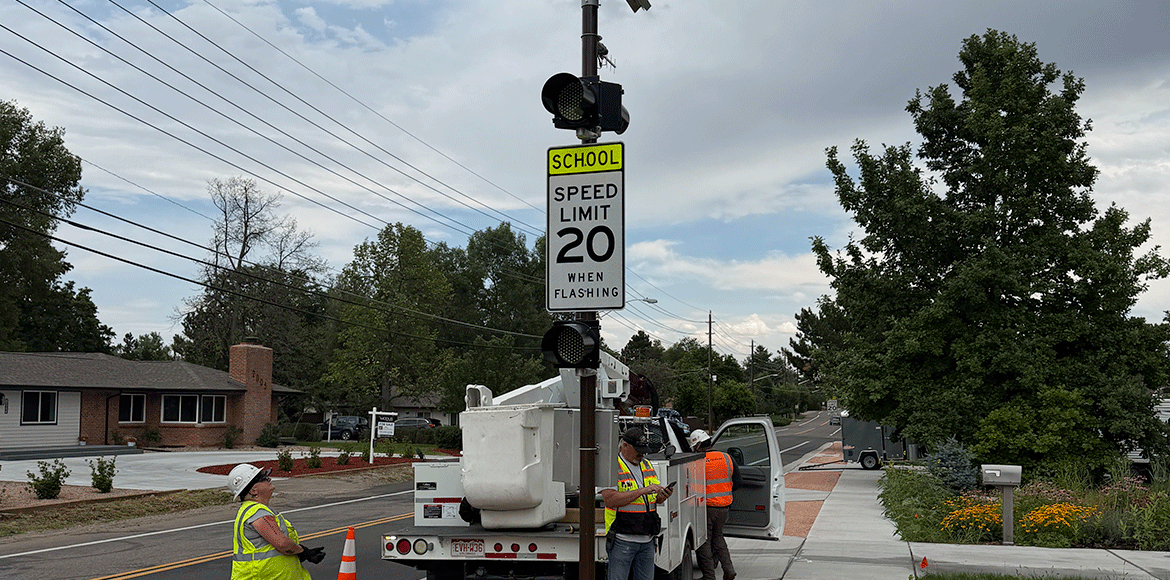
School zone speed limit flashers are among the most visible pieces of school-adjacent signal infrastructure. When they're working correctly, they're easy to overlook. When they're not, the consequences can be serious.
These systems typically operate on a programmed schedule tied to school hours, flashing during arrival and dismissal windows to alert drivers that a reduced speed limit is in effect. Some are integrated with the school district's calendar so they don't activate on days school isn't in session. Others run on fixed schedules that require manual updates when calendars change.
Flashers that are out of sync with actual school hours create a credibility problem. Drivers who see flashers active on a non-school day learn to discount them, which carries over to days when children actually are present. Keeping these systems calibrated and functioning correctly is a maintenance responsibility that directly affects how much protection they provide.
High-volume school crossings that lack full traffic signal control are strong candidates for rectangular rapid flashing beacons. RRFBs give pedestrians, including children crossing without adult supervision, a tool to actively alert drivers to their presence before stepping into the roadway. Research on RRFB effectiveness consistently shows significantly higher driver yielding rates compared to standard crosswalk markings and signage alone.
The start of a school year is a natural forcing function for municipalities to audit pedestrian crossing infrastructure near schools. Are push buttons functioning and accessible? Are walk interval timings appropriate for the actual users of the crossing? Is RRFB equipment where it needs to be and operating correctly? These aren't complicated questions, but they require someone to actually go out and check.
The signal and pedestrian infrastructure around schools doesn't need to fail dramatically to create safety problems. A walk interval that's two seconds too short, a flasher running on last year's schedule, or a push button with a loose connection are all low-visibility issues that only become obvious after something goes wrong.
The better approach is systematic review before the school year starts. That means pulling up timing plans and checking whether school-hour adjustments are in place, physically inspecting flashers and pedestrian equipment for functionality, and confirming that any construction or maintenance activity from the summer hasn't affected crossings near schools.
For municipalities juggling multiple projects and limited staff, that kind of proactive review often doesn't happen without a contractor partner who understands both the technical requirements and the calendar.
At Lighthouse Transportation Group, we support municipalities across Colorado and Oklahoma with the signal and pedestrian infrastructure work that keeps school zones functioning safely. That includes timing adjustments, flasher maintenance, and RRFB installation at crossings that need a higher level of pedestrian protection.
The school year starts on the same schedule every year. The infrastructure that serves it should be ready before the first bell rings.
We’re a small team that loves to create great experiences and make meaningful connections between builders and customers. Join our remote ream!


.gif)